Publications
Also on ORCID, Google Scholar and researchmap. All papers are open access (CC BY 4.0).
Preprints
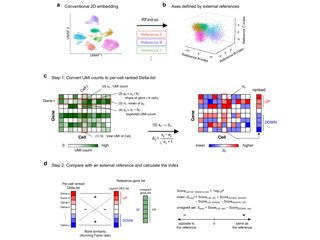
Introduces a method that places each cell on biological axes defined by external references (expression signatures, gene sets or genetic perturbations), and uses ~1,900 in vivo Perturb-seq knockouts as references to nominate candidate genes for each cell type.
Peer-reviewed papers
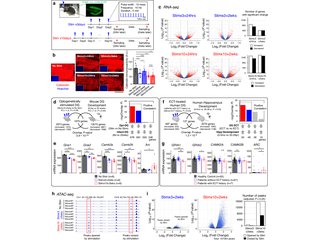
A study that modelled electroconvulsive therapy with repeated optogenetic stimulation of the mouse dentate gyrus and revealed that repetitive neuronal activation turns mature neurons into a long-lasting dematured state via nuclear reprogramming.
Media coverage
- Repetitive neuronal stimulation triggers nuclear reprogramming to revert mature neurons toward an immature-like stateEurekAlert! (Fujita Health University press release) · 2026-07-17
- ECT-like stimulation unlocks lasting immature-like state in adult mouse neuronsMedical Xpress · 2026-07-17
- ECT Reprograms Adult Neurons into a Youthful StateNeuroscience News · 2026-07-17
- ECT-like brain stimulation triggers unexpected nuclear reprogramming in mature neuronsNews-Medical · 2026-07-17
- Neuronal Stimulation Reverts Mature Cells to Immature StateMirage News · 2026-07-17
- Repetitive Neuronal Stimulation Reprograms Mature Neurons Into Immature StatesBioengineer.org · 2026-07-17
- Repetitive Neuronal Stimulation Reprograms Mature Neurons Into Immature StatesScienmag · 2026-07-17
- Электрошоковая терапия делает взрослые нейроны «незрелыми» и перезапускает мозгPronedra.ru · Russian · 2026-07-17 · “Electroshock therapy makes adult neurons “immature” and restarts the brain”
- 村野助教らの研究成果が国際誌『Nature Communications』に掲載されました藤田医科大学 システム医科学研究部門 · Japanese · 2026-07-17 · “Fujita Health University lab news (explainer)”
- 重复神经元激活通过核重编程调控细胞成熟状态生物通 eBiotrade · Chinese · 2026-07-18 · “Repetitive neuronal activation regulates cellular maturation state via nuclear reprogramming”
- Стимуляция мозга может временно возвращать зрелые нейроны в более пластичное состояниеMedicalInsider.ru · Russian · 2026-07-18 · “Brain stimulation may return mature neurons to a more plastic state”
- REPOPS zeigt: ECT-ähnliche Stimulation entkoppelt Reife-Zustand von NeuronenIT BOLTWISE · German · 2026-07-18 · “REPOPS shows: ECT-like stimulation decouples the maturation state of neurons”
- تحفيز الدماغ المتكرر يعيد برمجة الخلايا العصبية ويمنحها حالة أكثر مرونةAsharq News (الشرق للأخبار) · Arabic · 2026-07-18 · “Repeated brain stimulation reprograms nerve cells and makes them more flexible”
- Repeated Neuronal Stimulation Triggered Cyclin B-Linked Nuclear Reprogramming in MiceBrainASAP · 2026-07-20
- Brain Stimulation May Return Brain Cells to a More Plastic StateThe Japan Research Report · 2026-07-22
- How Electroconvulsive Therapy May Reset the Adult Brain: New Research Reveals Cellular Reprogramming and Circuit RemodelingUTHealth Houston, Department of Psychiatry and Behavioral Sciences · 2026-07-22
- 电休克疗法“百年冤案”平反!Nat Commun:不是粗暴放电,是给抑郁神经元做了一次“系统重装”生物谷 Bioon · Chinese · 2026-07-23 · “ECT is not a crude discharge but a “system reinstall” of neurons”
- Japonští vědci objevili metodu REPOPS, která navrací dospělé neurony do mladistvého stavuVěda.cz · Czech · 2026-07-24 · “Japanese scientists discover REPOPS, which returns adult neurons to a youthful state”
- How ECT-like stimulation unlocks lasting immature-like state in adult mouse neuronsHealth Medicine Network · 2026-07-28
- 反復神経過活動が引き起こす「核リプログラミング」を発見日本神経科学学会「神経科学トピックス」 · Japanese · 2026-07 · “Japan Neuroscience Society: topics for the public”
Social media and video
- Post on the paper and its original images in SSBD:repositoryX · SSBD (RIKEN) · 2026-08-17
- ECT Rewinds Neurons to a Youthful State - The Shocking MechanismYouTube · Edges Project · 2026-07-22
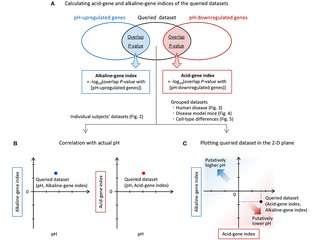
A meta-analysis of 281 human datasets from 11 CNS disorders showing that gene expression associated with lower brain pH is over-represented in disorders such as schizophrenia, bipolar disorder and autism.
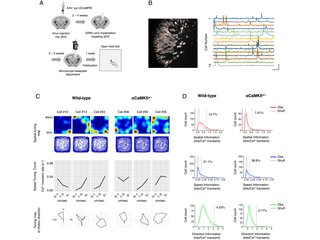
A study that used calcium imaging and machine learning in freely moving mice to reveal that position, speed and motion direction are independently encoded in populations of dentate gyrus neurons.
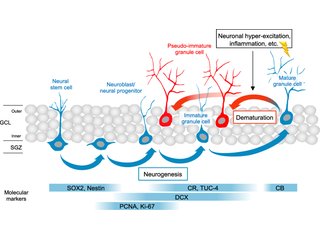
A review arguing that, because mature neurons can “dematurate” and re-express immature-neuron markers, these markers alone are not definitive evidence of adult neurogenesis in humans.
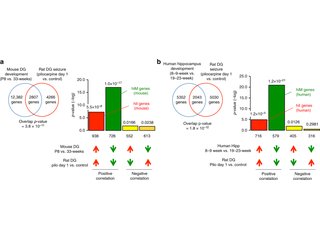
A study showing, across 87 disease datasets, that transcriptomic pseudo-immaturity induced by neuronal hyperexcitation is shared by multiple neuropsychiatric disorders, including schizophrenia, Alzheimer's disease and ALS.
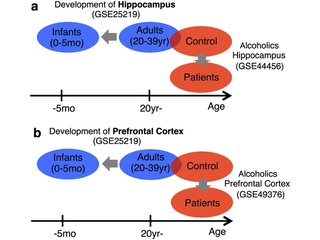
A study showing immature-like gene expression in the post-mortem hippocampus and prefrontal cortex of patients with alcoholism, with a dominant contribution of fast-spiking neurons.
Conference presentations
- 神経過活動に着目した精神疾患病態メカニズムの解明Award lecture (15th Young Investigator Development Program Encouragement Award), BCNP2026 Joint Annual Meeting, Utsunomiya, Japan (October 2026).
- シングルセルRNA-seqの解釈可能性を拡張する新規解析手法RFindの開発とその応用Poster, BCNP2026 Joint Annual Meeting, Utsunomiya, Japan (October 2026).
- Repetitive Neuronal Activations Regulate Cellular Maturation State via Nuclear Reprogramming.Poster, 63rd Annual Meeting of the American College of Neuropsychopharmacology (ACNP), Phoenix, AZ, USA (December 2024).
- Novel gene expression profiling method for postmortem brains of schizophrenia patients.Poster, 47th Annual Meeting of the Japan Neuroscience Society (NEURO2024), Fukuoka, Japan (July 2024).
- Repeated neural activations induce long-term structural plasticity of the nucleus.Poster, Society for Neuroscience Annual Meeting (Neuroscience 2023), Washington, DC, USA (November 2023).
- A novel evaluation method for biological heterogeneity among patients with schizophrenia.Poster, 53rd Annual Meeting of the Japanese Society of Neuropsychopharmacology, Tokyo, Japan (September 2023).